
Build a claim-evidence-reasoning worksheet that helps students connect claims, accurate evidence, and clear explanations. Use it alongside the Critical Thinking Guides, then adapt the examples with the Create Critical Thinking Exercises.
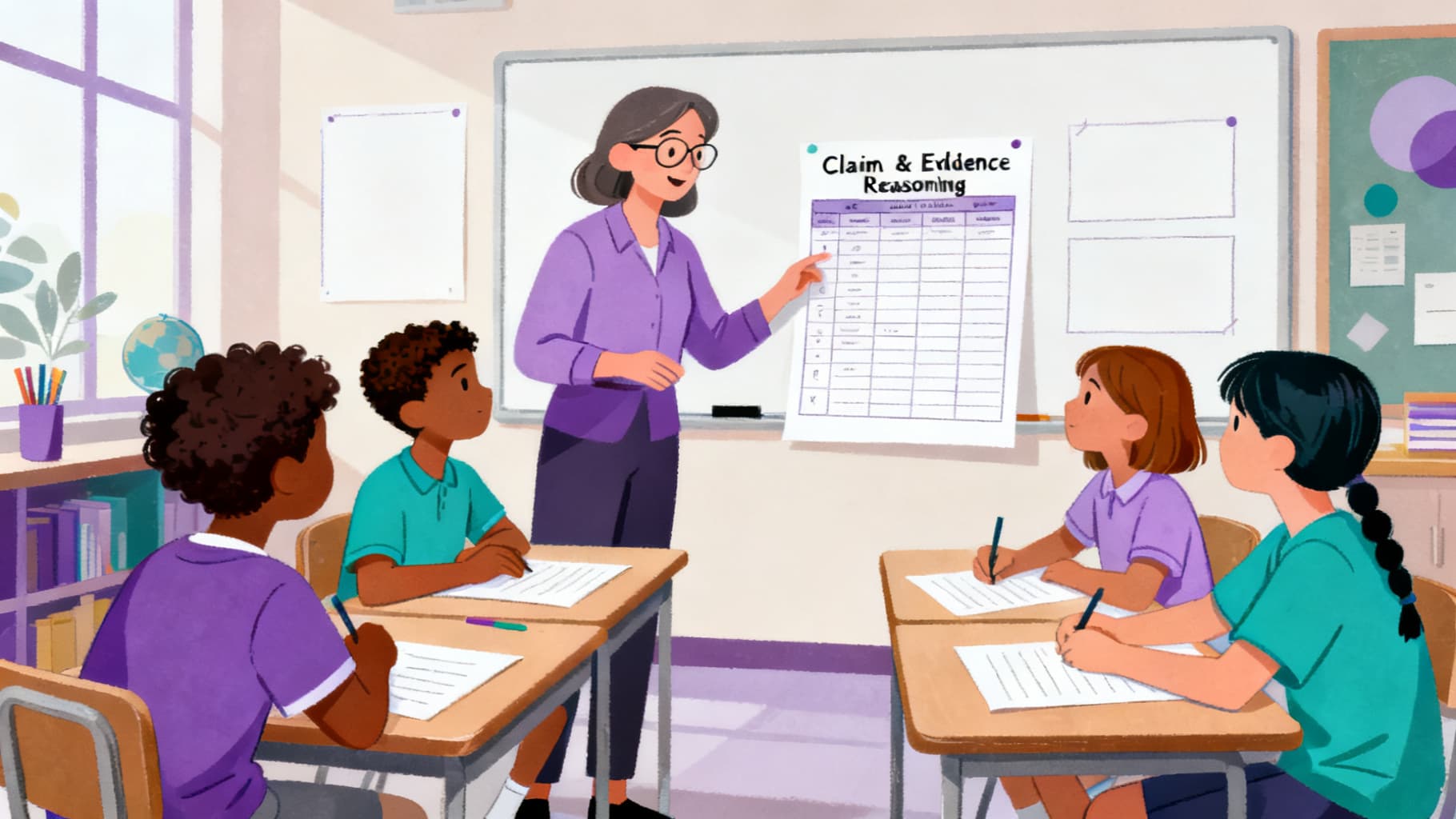
Understanding the CER Framework
Claim-Evidence-Reasoning (CER) is a writing framework that teaches students to construct scientific explanations and arguments. The Claim states what the student believes to be true. The Evidence provides specific data or observations that support the claim. The Reasoning explains why the evidence supports the claim by connecting it to scientific principles or logical rules.
CER originated in science education but works across disciplines. Any time students need to make and defend an assertion — in history, ELA, social studies, or math — the CER structure provides a scaffold for clear, evidence-based communication.
Designing an Effective CER Worksheet
A CER worksheet should guide students through each component with enough structure to prevent confusion but enough openness to allow genuine thinking.
- Prompt section: Present the question or phenomenon students will explain
- Claim box: Space for a one-sentence assertion that directly answers the question
- Evidence section: Multiple rows for recording specific data, observations, or quotes with source attribution
- Reasoning section: Space for explaining the logical connection between evidence and claim
- Self-check: Questions like "Does my evidence directly support my claim?" and "Have I explained WHY this evidence matters?"
Common Student Mistakes and How to Address Them
The most common CER error is weak reasoning — students state their claim, provide evidence, but never explain the logical connection. They assume the link is obvious. Teach students that reasoning answers the question "So what?" after presenting evidence.
Another common mistake is using opinions or general knowledge as evidence instead of specific, cited data. A worksheet that requires source attribution for each piece of evidence prevents this by making students point to exactly where their evidence comes from.
Scaffolding CER for Different Levels
For beginners, provide the claim and ask students only to find evidence and write reasoning. For intermediate students, provide the evidence and ask them to form a claim and explain the connection. For advanced students, present a phenomenon and ask them to complete all three components independently. This gradual release builds confidence and competence.
Helpful Related Resources
Related guide
What Is a Critical Thinking Exercise?
Understand what a critical thinking exercise is and how it helps learners analyze evidence, question assumptions, and explain reasoning.
Read guide →Related guide
Critical Thinking Exercises for Students
Use flexible critical thinking exercises for students that support evidence, reasoning, discussion, and reflection.
Read guide →Related guide
Compare Arguments Questions for Critical Thinking
Use compare arguments questions to help students evaluate claims, evidence, assumptions, counterclaims, and reasoning quality.
Read guide →Related guide
Critical Thinking Worksheets for Teachers and Parents
Create critical thinking worksheets that combine short scenarios, source evaluation, reasoning stems, and reflection prompts.
Read guide →Sources and Further Reading
- WebQuest.org: Creating WebQuests: Original WebQuest community resource associated with Bernie Dodge.
- ERIC: Problem-Based Learning: What and How Do Students Learn?: Educational Psychology Review article record for Hmelo-Silver (2004).
- Cambridge Handbook of the Learning Sciences: Project-Based Learning: Krajcik and Shin chapter on project-based learning.
- Library of Congress: A Taxonomy for Learning, Teaching, and Assessing: Library of Congress record for Anderson and Krathwohl's revised Bloom taxonomy.
Ready to build your own?
Generate critical thinking questions, hints, worksheets, and private guidance, then customize the exercise for your class.