
Use high school critical thinking exercises for argument analysis, evidence evaluation, media literacy, and decision-making. Use it alongside the Critical Thinking Guides, then adapt the examples with the Create Critical Thinking Exercises.

Raising the Bar for Adolescent Thinkers
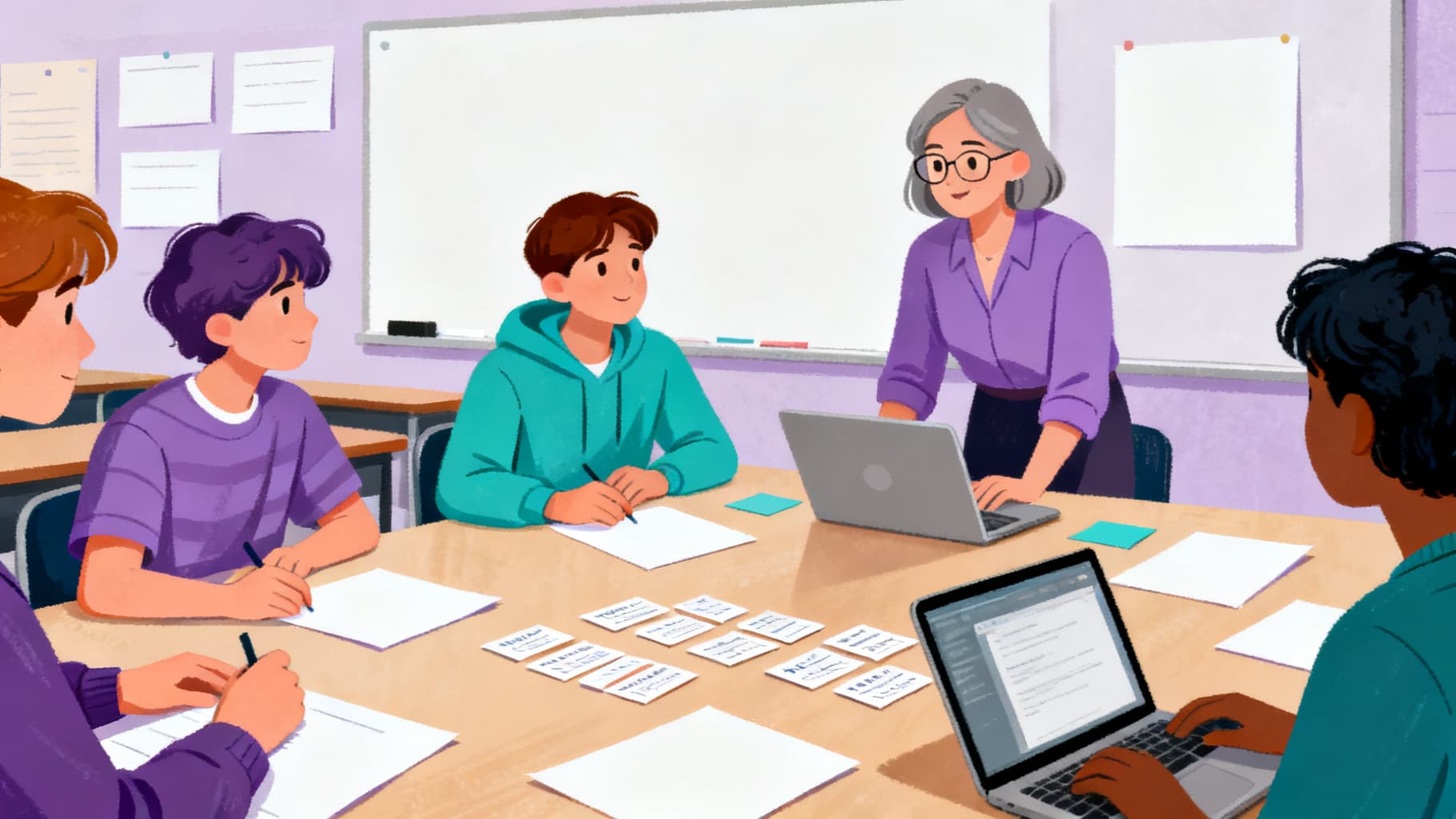
High school students can handle genuine intellectual complexity: ambiguous evidence, competing valid interpretations, ethical dilemmas without clean solutions, and arguments that require distinguishing correlation from causation. Critical thinking exercises at this level should mirror the reasoning demands students will face in college and professional life.
The goal is not just to think critically about school content but to develop transferable reasoning habits that apply to media consumption, civic participation, career decisions, and personal relationships.
Advanced Exercises for Grades 9-12
These exercises demand sustained analytical effort and tolerance for ambiguity.
- Argument Reconstruction: Give students a complex editorial and ask them to diagram its logical structure — premises, evidence, assumptions, and conclusion — then identify the weakest link.
- Policy Analysis: Present a proposed policy with supporting data and ask students to identify what the data shows, what it doesn't show, and what additional information would be needed to make a sound decision.
- Ethical Dilemma Discussion: Present scenarios where two legitimate values conflict (privacy vs. safety, individual freedom vs. collective welfare) and require students to articulate principles, not just preferences.
- Research Design Critique: Show students a study summary and ask them to identify methodological strengths and limitations.
Connecting Critical Thinking to College and Career Readiness
Frame critical thinking as a professional skill, not just an academic exercise. Lawyers evaluate evidence and construct arguments. Scientists design studies and interpret data. Business leaders analyze markets and make decisions under uncertainty. Engineers weigh tradeoffs and optimize solutions. Every career requires the ability to think clearly under complexity.
When students see critical thinking as preparation for adult competence rather than a school requirement, their engagement increases significantly.
Assessment at the High School Level
Assess reasoning quality, not just conclusions. Two students might reach opposite conclusions and both demonstrate excellent critical thinking if their reasoning is sound, their evidence is relevant, and they acknowledge limitations. Rubrics should reward the quality of the thinking process, not agreement with a predetermined answer.
Helpful Related Resources
Related guide
Critical Thinking Activities for Adults
Use critical thinking activities for adults in workplace learning, media literacy, civic discussion, and personal decision-making.
Read guide →Related guide
Evaluate Evidence Exercises for Students
Use evaluate evidence exercises to help students judge relevance, reliability, sufficiency, and connection to a claim.
Read guide →Related guide
Identify Bias Activities for Media Literacy
Teach students to identify bias with activities that compare language, sourcing, framing, missing voices, and evidence choices.
Read guide →Related guide
Critical Thinking Exercises for Students
Use flexible critical thinking exercises for students that support evidence, reasoning, discussion, and reflection.
Read guide →Sources and Further Reading
- WebQuest.org: Creating WebQuests: Original WebQuest community resource associated with Bernie Dodge.
- ERIC: Problem-Based Learning: What and How Do Students Learn?: Educational Psychology Review article record for Hmelo-Silver (2004).
- Cambridge Handbook of the Learning Sciences: Project-Based Learning: Krajcik and Shin chapter on project-based learning.
- Library of Congress: A Taxonomy for Learning, Teaching, and Assessing: Library of Congress record for Anderson and Krathwohl's revised Bloom taxonomy.
Ready to build your own?
Generate critical thinking questions, hints, worksheets, and private guidance, then customize the exercise for your class.