
Understand the essential parts of a WebQuest and how each section supports student inquiry and classroom management. Use it alongside the WebQuest Guides, then adapt the examples with the Generate a WebQuest.
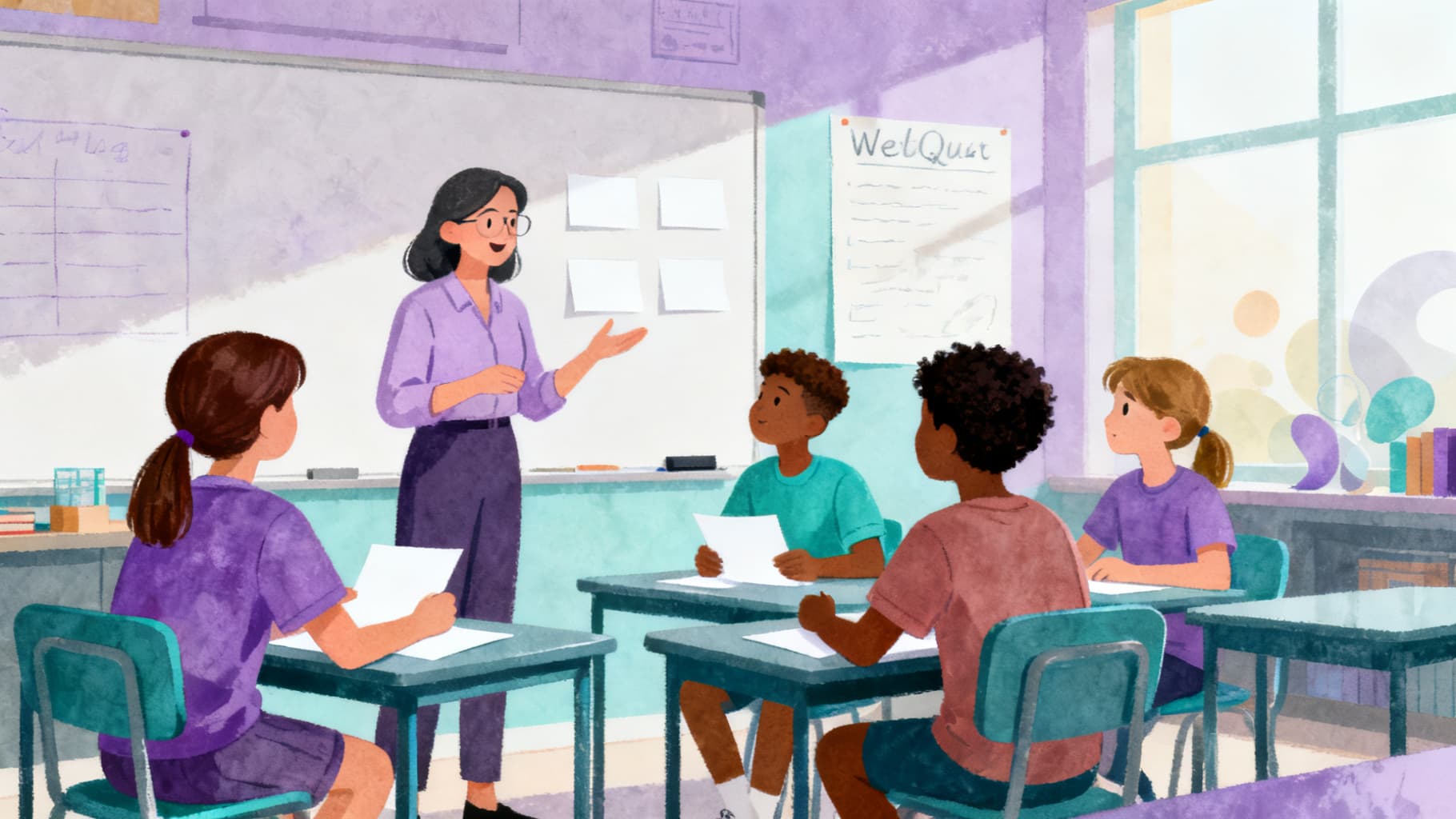
The Six Essential Components Explained
A complete WebQuest has six parts that work together: Introduction, Task, Process, Resources, Evaluation, and Conclusion. Each part serves a specific function in guiding student inquiry. Removing or weakening any component reduces the effectiveness of the whole activity.
These parts are not arbitrary. They mirror how professional researchers work: identify a question, define what a good answer looks like, plan the investigation, gather evidence, assess quality, and reflect on findings.
Introduction: Setting the Stage for Inquiry
The Introduction provides context and motivation. It might present a real-world scenario, pose a provocative question, or describe a problem that needs solving. A strong introduction makes students want to investigate — it creates a reason to care about the research ahead.
Keep introductions brief. Two to three paragraphs or a short video clip is enough. The goal is to activate curiosity, not to front-load all the content students will discover on their own.

Task and Process: The Engine of the WebQuest
The Task defines the final product — what students will create, present, or submit. The Process breaks the work into sequential steps that guide students from initial reading through analysis to final synthesis. Together, these two sections determine whether students engage in genuine inquiry or just go through the motions.
Write process steps as clear instructions with action verbs: read, compare, record, discuss, draft, revise. Each step should produce something visible — a completed row in a table, a highlighted passage, a written response — so you can monitor progress.
Resources, Evaluation, and Conclusion
Resources provides the curated links students will use. Evaluation shares the rubric so students know how their work will be assessed. The Conclusion asks students to reflect on what they learned and how their thinking changed.
The Conclusion is often the most neglected section, but it is where metacognition happens. When students articulate what surprised them or what they would investigate further, they consolidate learning and develop habits of reflective thinking.
Helpful Related Resources
Related guide
What Is a WebQuest? A Simple Guide for Teachers
A clear teacher-friendly explanation of what a WebQuest is, how it works, and why it supports research, collaboration, and critical thinking.
Read guide →Related guide
WebQuest Rubric: How to Assess Student Work
Build a WebQuest rubric that evaluates research quality, evidence use, collaboration, presentation, and reflection.
Read guide →Related guide
WebQuest Worksheet: What to Include and How to Use It
Design a WebQuest worksheet that keeps students focused on questions, sources, notes, evidence, and final responses.
Read guide →Related guide
WebQuest Template for Teachers: Structure, Sections, and Examples
Use a practical WebQuest template to organize introduction, task, process, resources, evaluation, conclusion, and teacher notes.
Read guide →Sources and Further Reading
- WebQuest.org: Creating WebQuests: Original WebQuest community resource associated with Bernie Dodge.
- ERIC: Problem-Based Learning: What and How Do Students Learn?: Educational Psychology Review article record for Hmelo-Silver (2004).
- Cambridge Handbook of the Learning Sciences: Project-Based Learning: Krajcik and Shin chapter on project-based learning.
- Library of Congress: A Taxonomy for Learning, Teaching, and Assessing: Library of Congress record for Anderson and Krathwohl's revised Bloom taxonomy.
Ready to build your own?
Start with a structured WebQuest draft, then customize the resources, rubric, and student questions for your class.